New Observations Reveal a New Type of Lateral Discharge in Lightning
Date:2025-12-02
A recent study by researchers from the Institute of Atmospheric Physics, Chinese Academy of Sciences, published in Geophysical Research Letters, reports the first observational evidence of lateral negative re-discharges occurring on negative leader channels. The finding provides new insight into how lightning channels remain electrically active and how their structures evolve before and after a return stroke. Prior to this study, negative-polarity lateral breakdowns had only been observed near the tips of positive leaders, and had not been documented along negative leader channels.
Using a self-developed very-high-frequency lightning interferometer with sub-microsecond temporal resolution and spatial accuracy on the order of several tens of meters, the research team captured this phenomenon during a positive cloud-to-ground lightning event on the Qinghai-Tibet Plateau. Combined VHF interferometric imaging and ground-based electromagnetic measurements show that short-duration lateral re-discharges appeared repeatedly along pre-ionized negative channels both before and after the return stroke.
Before the return stroke, the positive leader advanced steadily while the negative leader weakened. During this stage, small needle-like lateral re-discharges developed along almost the entire horizontal negative channel. These short bursts propagated toward the negative leader tip at roughly 8 × 10⁴ m/s, and their VHF radiation intensity was comparable to that of the needle discharges typically observed near positive leader tips.
After the return stroke, the observations recorded rapid discharges along existing negative channels as well as new lateral breakdowns extending into previously un-ionized air. These post-return-stroke processes quickly lengthened the negative channels and helped sustain the long-duration continuing current by maintaining channel conductivity.
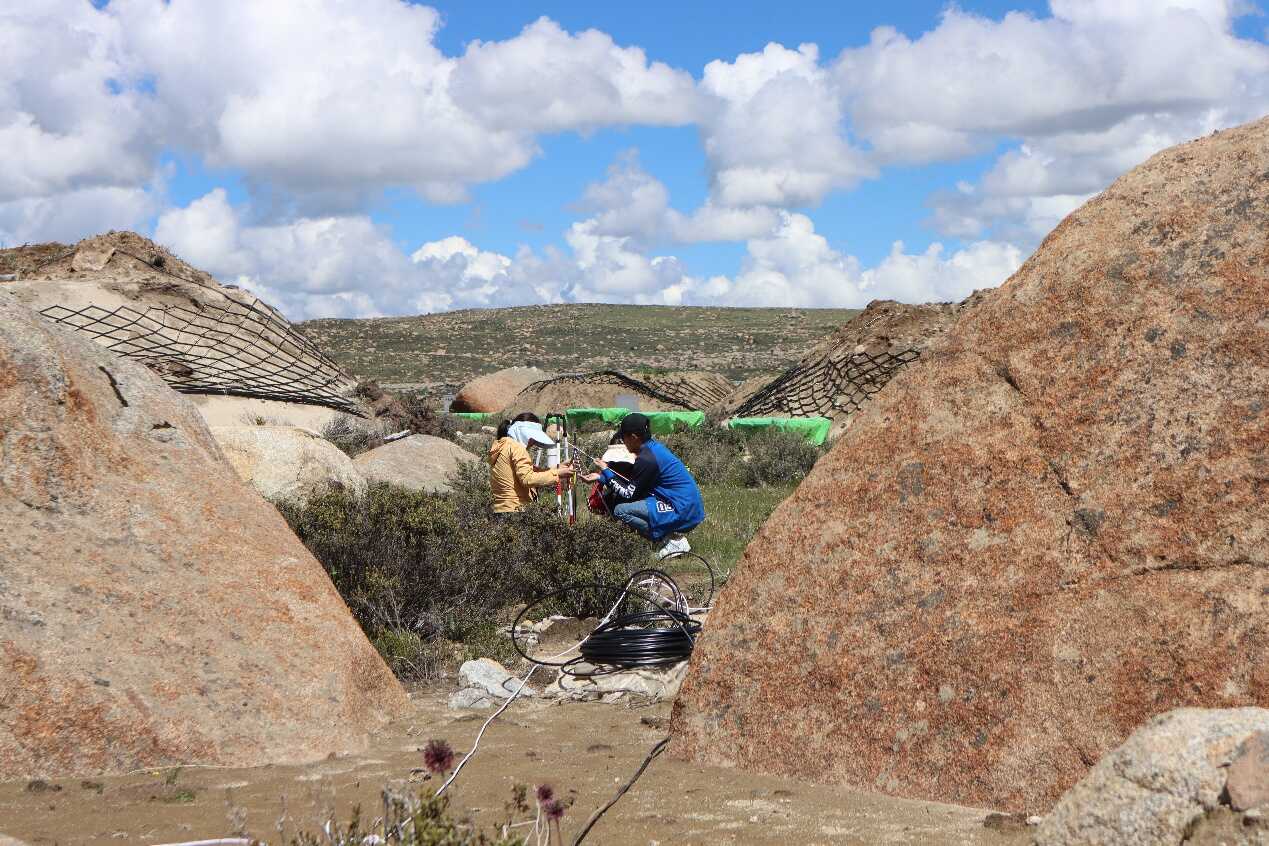
Field installation of the lightning observation instrument by the research team. (Image by Xu Chen)
“What really caught our attention,” said Prof. Qie Xiushu, corresponding author of the study, “was the correspondence between these re-discharges and the evolution of the channel potential. Gradual changes before the return stroke tended to reactivate weakened branches, whereas sharp increases afterward initiated new breakdown paths.”
The results indicate that the rate or magnitude of channel potential change plays a controlling role in determining whether a lateral re-discharge reactivates an existing path or initiates a new one. This mechanism clarifies how negative polarity channels evolve around the return stroke and how conductivity is maintained during the continuing current phase.
The study was supported by the Strategic Priority Research Program of the Chinese Academy of Sciences, the National Natural Science Foundation of China, and the Second Tibetan Plateau Scientific Expedition and Research Program.
Paper information:Sun, Z., Qie, X., Li, F., Liu, M., Wei, L., Liu, D., et al. (2025). Lateral negative re-discharges on the negative leader in a positive cloud‐to‐ground lightning flash. Geophysical Research Letters, 52, e2025GL117167. https://doi.org/10.1029/2025GL117167