GoMars Modeling for Safer Martian Missions
Date:2025-12-14
The accuracy of weather predictions can directly affect the success of plans large and small, whether it be a backyard picnic or a rocket launch. Importantly, the same rule applies to missions beyond Earth’s atmosphere, including Mars.
Mars is a dusty planet composed of a vast, dry desert with no easily accessible sources of liquid water. Much like Earth, dust is lifted off the surface of Mars by wind and rotating columns of air, moves through the atmosphere, and is deposited back on the planet’s surface through sedimentation. The Martian dust cycle is controlled by a variety of factors, including interactions between the planet surface and the atmosphere, seasonal variations and the development of massive dust storms that can occur on a global scale.
In order for humans to successfully visit or eventually inhabit Mars, we must be able to predict Martian dust cycles and large-scale dust storms with a reasonable amount of accuracy, allowing engineers to plan critical mission launch windows during ideal conditions.
To address this issue, a team of scientists from the Institute of Atmospheric Physics (IAP) in the Chinese Academy of Science (CAS) in Beijing, China recently performed a 50-year simulation of the Martian dust cycle from the Global Open Planetary Atmospheric Model for Mars (GoMars). This new model, the first of its kind independently developed by Chinese scientists, is capable of accurately predicting different characteristics of Martian dust cycles and global-scale dust storms.
The researchers published their study on December 13, 2025 in the journal Advances in Atmospheric Sciences.
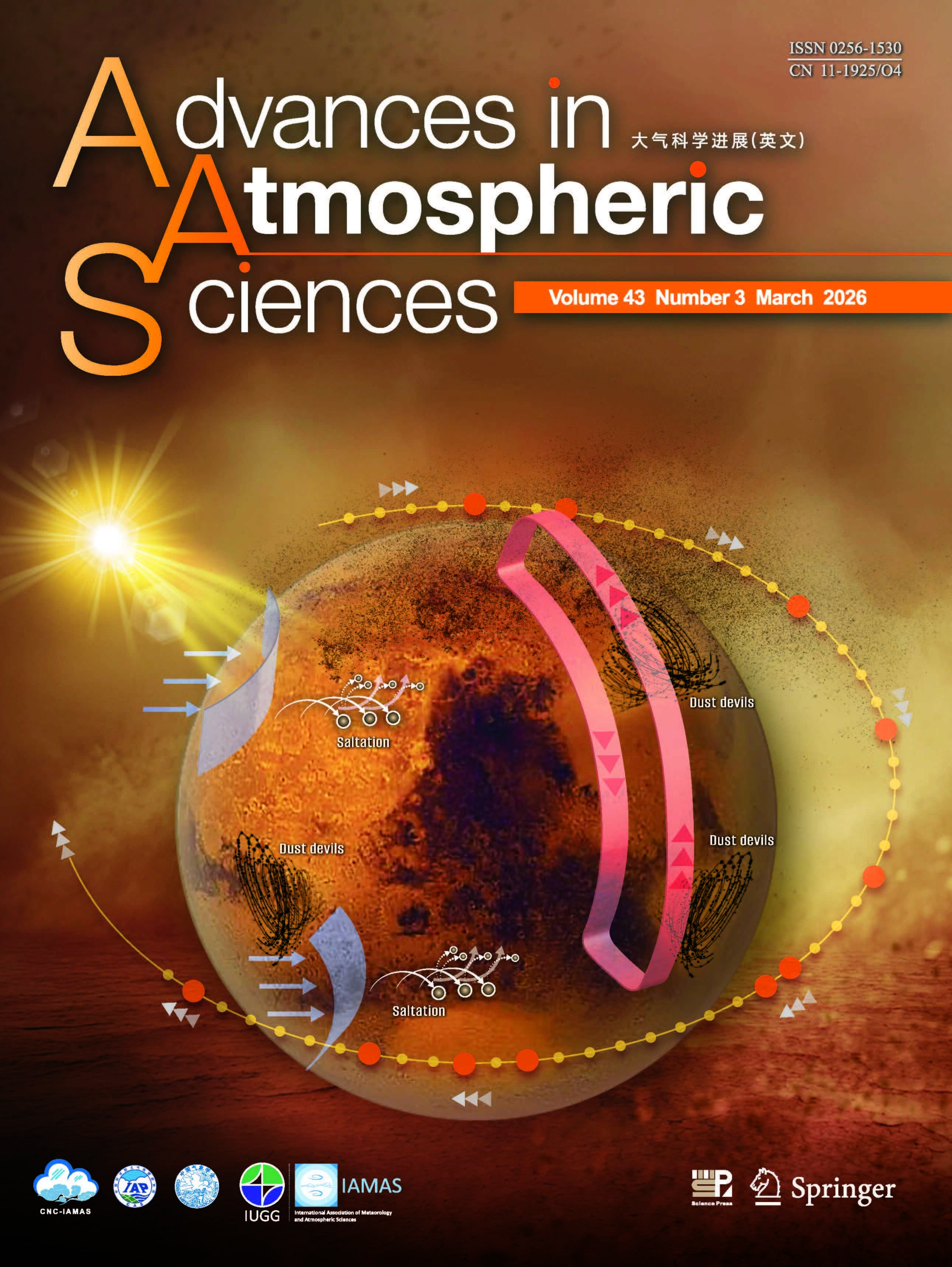
The study is featured on the cover of the latest issue of Advances in Atmospheric Sciences (AAS). The Martian atmosphere is primarily characterized by a dust cycle that exhibits significant interannual variability, largely driven by episodic Global Dust Storms (GDSs). In a 50-year simulation, the GoMars model consistently reproduces 11 spontaneous GDSs at irregular intervals, employing a fully interactive dust scheme. (Image by AAS)
“The Martian dust cycle is a complex system that exhibits pronounced diurnal, seasonal, and interannual variability. Accurately simulating the Martian dust cycle remains a central objective as well as a significant challenge in the development and refinement of Mars General Circulation Models (MGCMs), which can be used to support [China’s] future Mars exploration missions,” said Liu Shuai, PhD candidate at National Key Laboratory of Earth System Numerical Modeling and Application (LabESM) at the IAP in the CAS in Beijing, China and first author of the research paper.
The team was able to corroborate their dust cycle simulation by comparing atmospheric predictions to the Mars Climate Database (MCD) and Mars Climate Sounder (MCS) observations. If atmospheric data was not available for comparison during a particular time period, the GoMars predictions were compared to other available MGCMs (e.g., MarsWRF). GoMars modeling predicted consistent seasonal and spatial dust cycle patterns compared to other MGCMs.
“The [50-year] simulation successfully captures the multi-timescale variability characteristics of the Martian dust cycle and particularly reveals the ability of the model to consistently and realistically reproduce the irregular intervals of global dust storm[s], as observed, as well as the evolutionary processes of certain types of global dust storms—a long-standing challenge and recognized focus in international Martian atmospheric modeling,” said Liu.
For example, the simulation predicted that peak dust devil lifting (DDL), or the greatest amount of dust that heated, swirling columns of air can lift from the Martian surface into the atmosphere, occurs at 12:00-13:00 local time, which matches the Mars Pathfinder measurements. GoMars was also capable of accurately predicting the location of intense dust devil activity in Amazonis, a region identified as a major dust devil hotspot on Mars.
The current iteration of the GoMars MGCM is far from perfect, however, and the team has identified ways their dust cycle simulations can be improved.
“The next step will focus on advancing the model toward higher resolution, while continuously optimizing its dynamical core and physical parameterizations. Key improvements will include the incorporation of more realistic surface dust and sand source information, improved representation of dust-related physical processes, and an expanded simulation of the Martian water cycle,” said Dong Li, senior researcher at LabESM/IAP and co-author of the paper.
Over the long term, the team aspires to predict Martian dust cycles and storms with the same accuracy we predict weather here on Earth.
“The ultimate goal is to accurately reproduce the diverse types of dust storms observed on Mars and to investigate the underlying mechanisms that remain poorly understood. In addition, efforts will be made to assimilate observational data from Mars exploration missions to establish a comprehensive numerical prediction system for Mars, enabling meteorological support for future exploration activities,” said Wang Bin, senior researcher at LabESM/IAP and co-author of the research article.