New Study Uncovers the Lingering, Evolving Threat of "Thirdhand Smoke" in Our Homes
Date:2025-12-16
While the dangers of secondhand smoke are widely recognized, a new study in Building and Environment reveals a more persistent and stealthier hazard hiding in our indoor spaces: "Thirdhand Smoke." This residue, which lingers on surfaces long after a cigarette is put out, is not just a stale smell but a dynamic source of continuous air pollution, according to a recently published research from the Chinese Academy of Sciences.
Thirdhand smoke refers to the toxic mix of chemicals that cling to walls, furniture, carpets, curtains, and other surfaces after tobacco smoke clears. Unlike secondhand smoke, which you breathe in directly, this residue can continuously re-emit pollutants back into the air and undergo chemical changes over time, creating a long-term exposure risk.
A research team led by Professor Sun Yele from the Institute of Atmospheric Physics has, for the first time, mapped the real-time evolution of thirdhand smoke in indoor environments. Using advanced air monitoring technology, the team tracked both tiny particles and invisible gases released from contaminated surfaces.
The findings reveal a stark difference between secondhand and thirdhand smoke. While secondhand smoke particles fade quickly, thirdhand smoke maintains a stable, low-level presence in the air for extended periods. More importantly, the chemical "fingerprint" of the particles changes, indicating that the residue becomes more nitrogen-rich and potentially more harmful over time.
The study also identifies how our homes trap this pollution. Porous materials like wool carpets or fabric upholstery act as deep "reservoirs," soaking in tobacco chemicals. These reservoirs then slowly release pollutants, making them resistant to simple airing out and prolonging contamination for hours or even days.
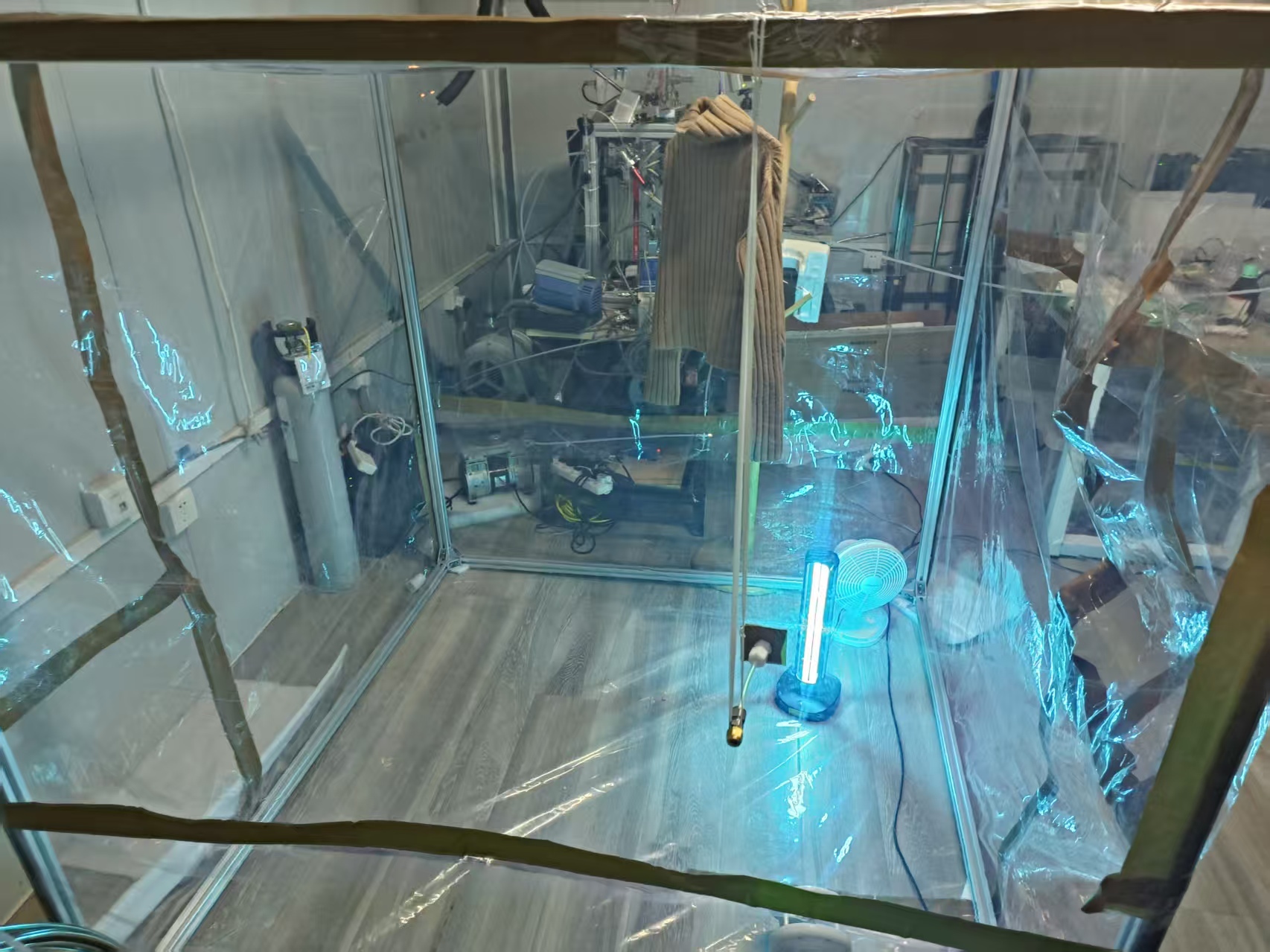
A wool sweater exposed to thirdhand smoke is suspended within a custom-built Teflon film chamber for controlled ozone oxidation experiments. (Image by Yang Liu)
The research outlines a three-stage release pattern: an initial burst of gases, followed by a hours-long phase of steady release of nicotine-related compounds, and finally a long, slow "tail" of other chemicals.
"The key takeaway is that thirdhand smoke is not a static stain; it's an active and ongoing source of pollution in a room," said Professor Sun Yele, the study's corresponding author. "The smoking session might end, but the release of hazardous compounds continues, exposing people to low levels of toxins long after the fact. This turns our homes into environments of chronic, low-dose exposure."
This work provides critical scientific evidence for public health guidelines, highlighting the need to consider thirdhand smoke in tobacco control policies and indoor air quality standards. It offers new chemical markers to detect this lingering contamination.