New Study Reveals Weakening of Circum-global Teleconnection Pattern Under Future Warming and its Impact on Heatwaves
Date:2026-01-06
The Circum-global Teleconnection Pattern (CGT) is a key mode of atmospheric variability during boreal summer, identified by an upper-tropospheric wave train propagating along the subtropical jet. CGT is one of the critical drivers of Northern Hemisphere mid-latitude heatwaves. However, how the structure of CGT responds to global warming and its effect on future heatwave characteristics remains inconclusive.
This study, recently published in Geophysical Research Letters, unravels the robust weakening of CGT under global warming and elucidates its impact on regional heatwaves. The research was led by Yu Hanzhao, a Ph.D. student at the Institute of Atmospheric Physics (IAP), Chinese Academy of Sciences, and the University of Chinese Academy of Sciences (UCAS).
“Previous studies paid little attention to forced change of CGT under greenhouse warming.” Yu explained, “We found that this wave train will weaken drastically in the future”
The research team used 34 climate models in Coupled Model Intercomparison Project Phase 6 (CMIP6) and revealed that the amplitude of CGT wave train will decrease robustly in a high-emission future, with only 68% of the present magnitude by the end of this century. The uniformly declined amplitude is manifested in decreased wind anomalies from Eurasia to North Pacific.
The authors further examined the underlying mechanism by conducting Rossby Wave Source diagnosis. Results show that the atmospheric circulation anomalies over eastern Mediterranean significantly weakens under global warming, which will act as an upstream signal and affect the downstream regions over Eurasia, thus leading to the reduced CGT amplitude.
How will weakened CGT influence the mid-latitude heatwaves? The authors found that CGT-related heatwave duration increases significantly from 5.5 days to 7.0 days over Eastern Europe, Tibetan Plateau, Northeastern Asia and North America while the duration declines evidently from 9.2 days to 7.5 days over Middle East. The major shift of regional heatwave duration is induced by high-level atmospheric circulation changes related to the weakened CGT.
“This study unravels the robust change on CGT structure under global warming,” said Professor Zhou Tianjun, the corresponding author of the study and a senior research scientist at IAP/CAS and the University of Chinese Academy of Sciences. “We also highlight its impact on the change of heatwave events worldwide and the potential threat to crop yield and ecosystems.”
By elucidating the key role of Mediterranean circulation on the weakening CGT, this study provides new evidence on the changing effect of atmospheric mode of variability on heatwave features under global warming.
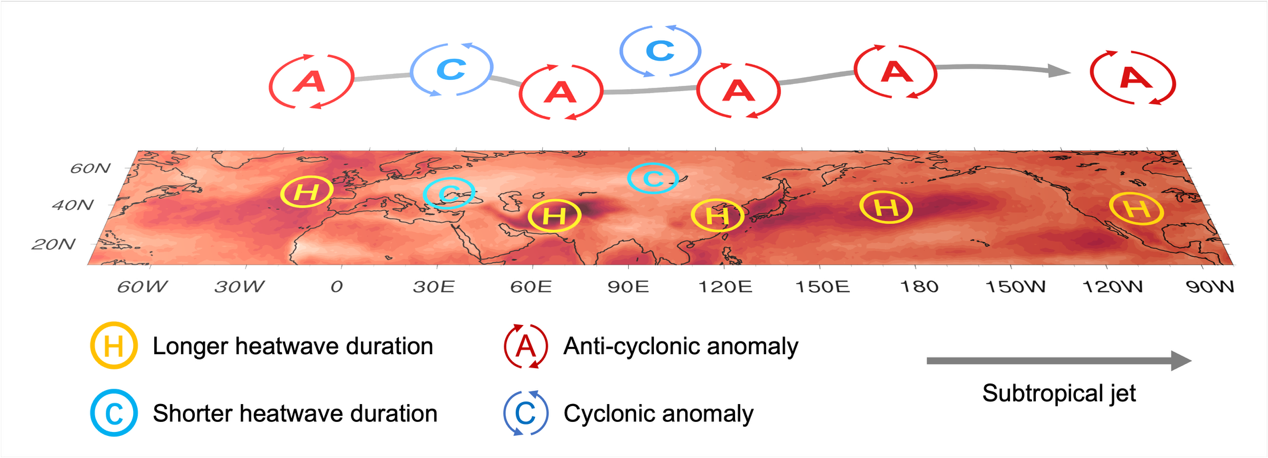
Schematic of CGT and its impact on heatwave. The upper-tropospheric wave train is CGT, and the anti-cyclonic (cyclonic) anomaly can lead to longer (shorter) duration of heatwave. (Image by Yu Hanzhao)
Paper info:
Yu, H., & Zhou, T. (2025). Weakened Circum-Global Teleconnection Pattern Under Global Warming Can Modulate Heat Extremes Across Eurasia, 52(24), e2025GL116358. https://doi.org/10.1029/2025GL116358