Mechanistic Insights from a New Regional Earth System Model Advance East Asian Summer Climate Simulation
Date:2026-01-23
The East Asian climate is profoundly influenced by complex interactions between the atmosphere, ocean, and land. A research team led by Prof. Dan Li at the Institute of Atmospheric Physics, Chinese Academy of Sciences, has developed the Regional Integrated Earth Model System version 4.0 (RIEMS4.0). The team’s recent study published in the Journal of Geophysical Research: Atmospheres provides new, mechanistic insights into how regional air-sea coupling shapes the East Asian summer climate, representing a significant advancement in the realism of regional climate simulations.
The study conducted a rigorous comparative analysis of the RIEMS4.0 (air-sea coupled), its standalone atmospheric component (WRF), and a CMIP6 multi-model ensemble for the period 1991–2014. Results demonstrate that the coupled RIEMS4.0 significantly outperforms the uncoupled simulations in reproducing the spatial pattern of summer daily mean and maximum surface air temperatures over East Asia.
“A key improvement is the substantial reduction of the persistent warm bias in WRF over eastern China by approximately 0.7°C in root mean square error.” Dr. Li Kai, the first author of the study, said excitedly.
The superior performance is mechanistically traced to the model’s more realistic representation of key physical processes. By explicitly coupling the ocean and atmosphere, RIEMS4.0 better simulates the surface sensible and latent heat flux exchange, which modulates the energy supply to the atmosphere. Furthermore, it improves the simulation of cloud-radiative processes and the land-sea thermal contrast. This research establishes regional air-sea coupling as an essential, active driver—not just a passive boundary condition—for achieving accurate historical climate simulations in regional models.
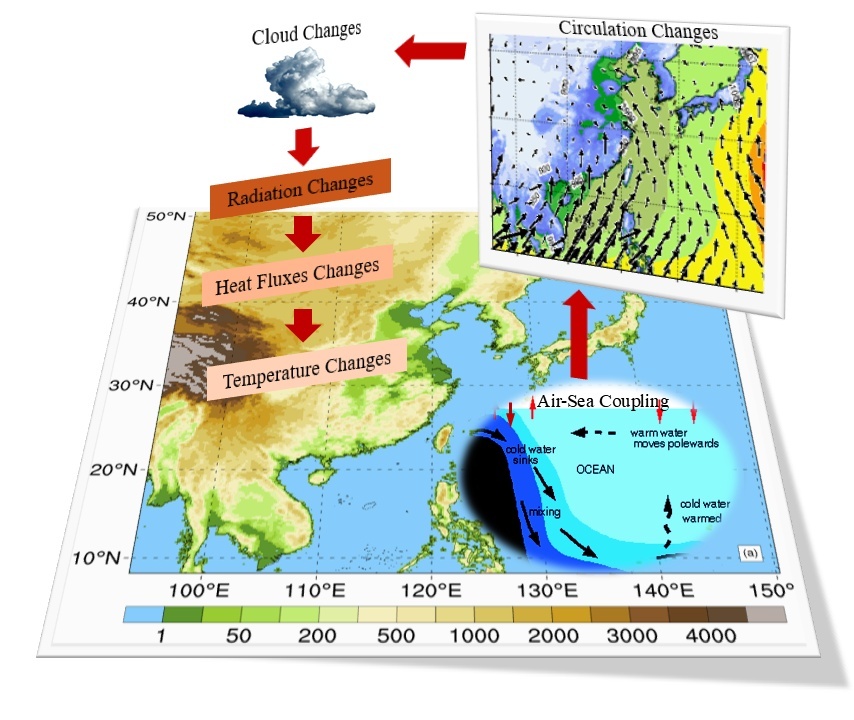
Schematic diagram illustrating the physical mechanisms by which the regional earth system model RIEMS4.0 improves the simulation of the climatology of summer mean temperature and extreme high temperatures for the historical period (1991–2014) in East Asia. (Image by Li Kai)
Building on the RIEMS4.0 framework, the team also investigated the role of air-sea coupling in the East Asian summer monsoon rainfall. Their research published in npj Climate and Atmospheric Science found that under present-day conditions, the coupling acts to reduce summer precipitation over land. This effect is attributed to a chain response involving enhanced shortwave radiation, a modulated land-sea thermal gradient, weakened oceanic evaporation, and consequently, reduced moisture transport inland.
“Our work highlights the coupling's integral role in simulating not just thermodynamics but also the regional hydrological cycle.” Said Prof. Dan Li.
So how does RIEMS4.0 work in a real world?
The team explored its practical value by simulating extreme events, such as the record-breaking 2020 meiyu event in the Yangtze-Huaihe River Valley. As the team reported in Advances in Atmospheric Sciences , the coupled model markedly improved the simulation of the event's spatial structure, daily evolution and effectively reduced the wet bias present in atmosphere-only model. Mechanism analysis revealed that the regional ocean-atmosphere coupling over the western North Pacific altered surface turbulent heat fluxes. This change subsequently modulated atmospheric instability and the intensity/position of the Western North Pacific Subtropical High (WNPSH), a key circulation system steering moisture. The adjusted circulation, combined with changes in land-sea thermal contrast, ultimately shaped the extreme precipitation pattern.
“This case study confirms the critical importance of incorporating air-sea coupling for reliable simulation and process understanding of high-impact weather extremes.” Said Prof. Dan.
Collectively, these studies utilizing RIEMS4.0 establish a clear mechanistic linkage between regional air-sea coupling and principal characteristics of the East Asian summer climate, encompassing mean states of temperature and precipitation as well as extreme events. The model constitutes a robust and reliable platform for regional climate risk assessment, process-oriented investigation, and attribution analysis. Future efforts will prioritize further refinement of the model's physics and framework, alongside an expansion of its application to address critical challenges such as simulations under carbon neutrality scenarios and the projection of coupled hydrological-ecological impacts, thereby contributing valuable tools for climate adaptation and mitigation strategies.
Article Information:
Li, K., Dan, L.*, Zou, L., Zheng, H., Xu, Z., Tang, J., et al. (2026). Mechanistic insights into regional air-sea coupling effects on East Asian summer climate: A comparative modeling study with a new regional earth system model. Journal of Geophysical Research: Atmospheres, 131, e2025JD044975. https://doi.org/10.1029/2025JD044975
Li, K., L. W. Zou, L. Dan, H. Zheng, Z. F. Xu, J. P. Tang, F. Q. Yang, W. L. Fei, T. T. Zhang, C. X. Shi, and Z.-L. Yang*. (2025). The role of regional ocean–atmosphere coupling in simulating the 2020 extreme mei-yu event. Adv. Atmos. Sci., 42(5), 904−920, https://doi.org/10.1007/s00376-024-4065-2.
Peng, J*., Li, K.*, Dan, L. et al. (2023). Sea–air coupling leads to a decrease in precipitation in East Asia under present day conditions that is partially alleviated in future simulations. npj Clim Atmos Sci 6, 174. https://doi.org/10.1038/s41612-023-00498-w