Are Climate Models Detecting Monsoon Changes a Decade Too Early? “Super-Simulations” Say “Yes”
Date:2026-02-26
Changes in rainfall within global monsoon regions affect the livelihoods of billions. For years, climate models have suggested that the fingerprint of human-caused climate change on monsoons would become visible by a certain time. But what if that timeline is wrong? A new study published in Advances in Atmospheric Sciences suggests the signal may not emerge until a full decade later than previously estimated.
Recently, a research team led by Professor Wang Lu from Nanjing University of Information Science and Technology, in collaboration with Associate Researcher Xiaolong Chen from the Institute of Atmospheric Physics at the Chinese Academy of Sciences, has found a new way to answer this question. They analyzed 550 simulations from eight different climate models—a “super-simulation” approach that provides much clearer insights than traditional methods.
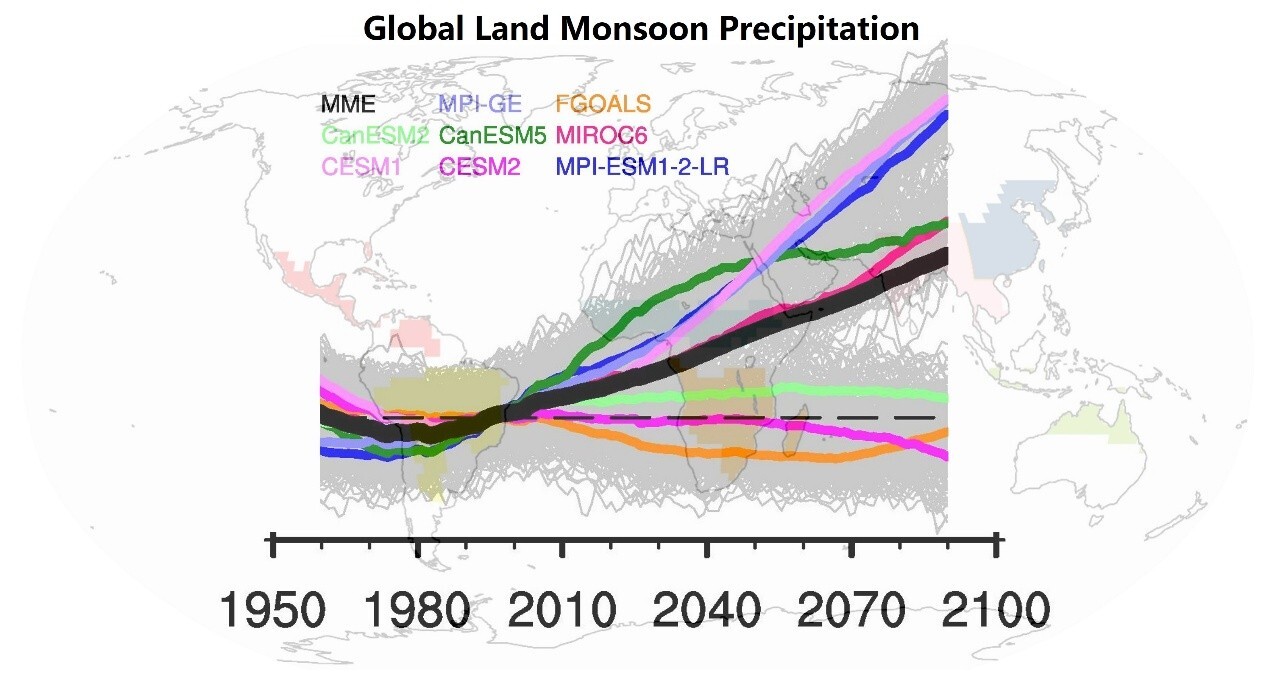
Global land monsoon precipitation projection in multi-model super large ensembles. (Image by Chen Xiaolong)
The team discovered that under a high-emission future scenario, projection uncertainty stems from a tug-of-war between two factors: model uncertainty--differences in how various models respond to global warming; and internal variability--the climate system's natural fluctuations.
Their influence shifts over time. After 2080, model differences become the main source of uncertainty as the human-caused warming signal strengthens. But before 2050, nature’s own variability is the dominant driver of uncertainty. This natural “noise” is especially strong at local scales and in specific regions like Australia.
A crucial finding of this research is that traditional analysis methods have been getting the timing wrong. These conventional approaches—which use mathematical fitting to extract patterns from limited data—have been mislabeling some natural climate variations as human-caused changes.
“In the past, we underestimated nature's ‘noise’ while overestimating the ‘signal’ from human activities,” explained Chen Xiaolong, the corresponding author.
Due to this misjudgment, the traditional methods estimated that the “time of emergence” (ToE) for the systematic impact of human activities appears roughly 10 years earlier than it actually will.
A 10-year difference is crucial for policy planning. When countries develop climate adaptation strategies for the period before 2050, they must account for the substantial natural variability that can mask or mimic human-caused changes. Relying on overly optimistic projections could lead to poorly timed or misdirected policies.
To truly understand future monsoon changes, single-model projections aren't enough. Only through massive “super-simulations”—running many models many times—can scientists clearly distinguish the human-caused climate change signal from nature’s complex background noise.
“This approach provides a more reliable foundation for global climate action.” Said Prof. Wang Lu, the lead author of the study.