Reconstructing Solar Radiation, Ultraviolet, and Photosynthetically Active Radiation Across China Using Deep Learning
Date:2026-03-06
Solar radiation plays a critical role in shaping Earth's climate and supporting life. Among its components, downward surface solar radiation (DSSR), ultraviolet radiation (UVR), and photosynthetically active radiation (PAR) each have unique effects on energy production, human health, air quality, and ecosystem function. However, obtaining accurate, high-resolution radiation data across a large country like China has long been a challenge due to the high cost and complexity of ground-based observations.
A research team from the Institute of Atmospheric Physics at the Chinese Academy of Sciences has developed a new approach to overcome this limitation. Using an advanced deep learning model known as the FT-Transformer, the team reconstructed hourly datasets of DSSR, UVR, and PAR at a 0.1° resolution—covering the entire country from 2005 to 2023. These datasets were generated by integrating multiple data sources, including ground observations from the Chinese Ecosystem Research Network (CERN), reanalysis products, and satellite data.
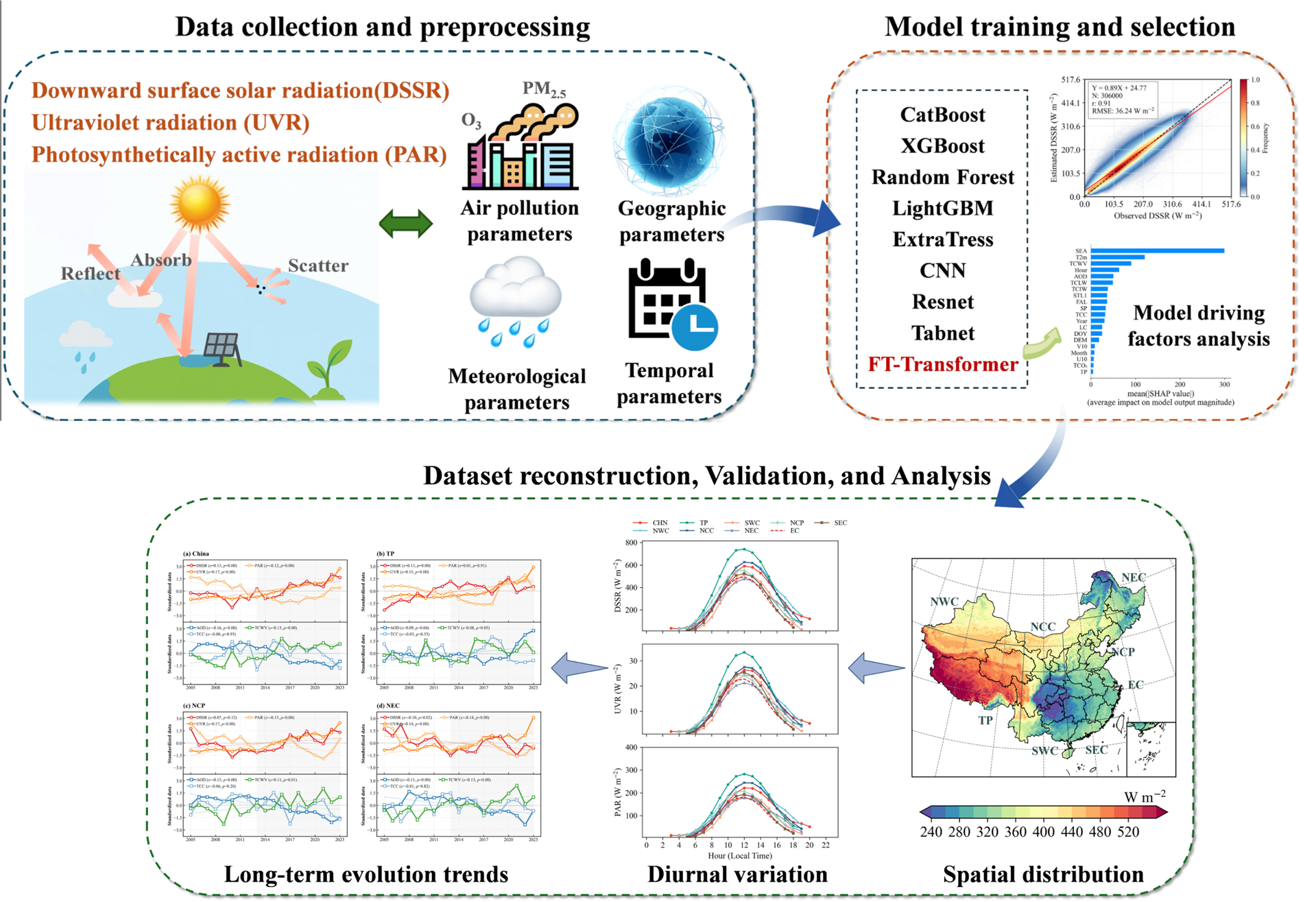
High-quality downward surface solar radiation, ultraviolet radiation, and photosynthetically active radiation over two decades in China (Image by Zhang et al., 2026)
“Ourproducts demonstrate high reliability and accuracy.” said Prof. Wang Lili, corresponding author of the study published in Atmospheric Research. “We validated them against independent ground-based measurements and compared them with widely used global datasets such as CERES, CAMS, and ERA5.” The datasets achieved high accuracy with the coefficient of determination (R2) values of 0.78–0.83, 0.87–0.89, and 0.96–0.98 at hourly, daily, and monthly levels, respectively.
The reconstructed datasets reveal notable trends: DSSR and UVR have increased significantly across most regions of China since 2013. This change is largely attributed to reduced aerosol emissions resulting from China’s Air Pollution Prevention and Control Action Plan. In contrast, PAR shows an overall declining trend, with strong regional differences. Further analysis indicates that year-to-year variations in cloud cover and aerosol levels explain 80% to 93% of the variability in DSSR and UVR in eastern and central China.
These open-access datasets offer valuable resources for researchers and policy makers working in solar energy, climate, and ecosystem management.
This study was supported by the Strategic Priority Research Program of the Chinese Academy of Sciences.
Paper info:
Zhang, J., Wang, L., Zhang, L., Du, W., Tao, M., Qin, T., Jin, X., Hu, B. (2026). Reconstructing hourly downward surface solar radiation, ultraviolet radiation, and photosynthetically active radiation using a transformer-based deep learning model in China. Atmospheric Research, 336, 108862. https://doi.org/10.1016/j.atmosres.2026.108862