New Perspective Article Highlights the Domino Effect of Climate Tipping Points
Date:2026-04-18
A new Perspective article published in National Science Review highlights an urgent challenge in Earth system science: climate tipping points may not occur in isolation, but can interact and trigger cascading changes across the planet’s interconnected systems. The study was led by Jun Meng from the Institute of Atmospheric Physics, Chinese Academy of Sciences, and Deliang Chen from Tsinghua University.
As global warming intensifies, critical components of the Earth system are being pushed closer to thresholds of instability. These tipping elements include major climate, oceanic, ecological, and cryospheric subsystems that may shift abruptly and become difficult to reverse. The article argues that the greatest risk lies not only in the tipping of individual systems, but in their potential to trigger one another, producing a domino effect of global change.
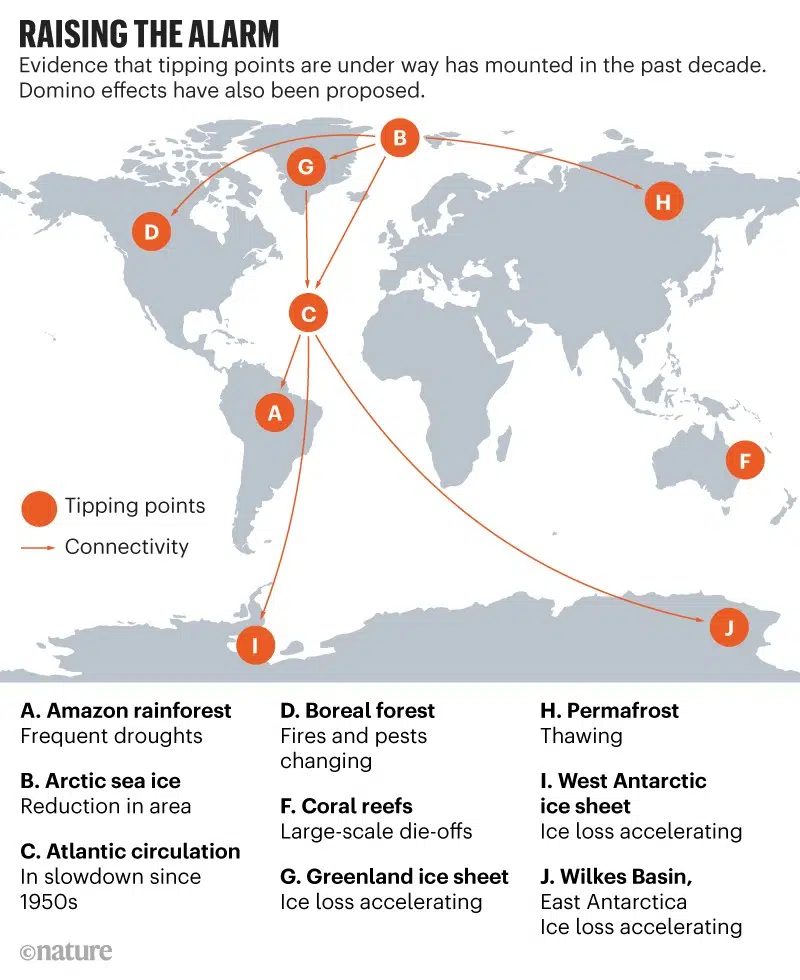
The tipping points of climate change. (Image by Vote Earth Now)
The authors emphasize that such risks must be understood from a genuinely multidisciplinary perspective. The atmosphere, ocean, biosphere, cryosphere, and human systems are deeply connected through nonlinear feedbacks, teleconnections, and cross scale interactions. Once destabilized, one subsystem may influence others, amplifying risks to ecosystems, food security, coastal communities, and human society.
Importantly, the article stresses that multidisciplinary collaboration is not a simple addition of knowledge from different fields. Addressing climate tipping cascades requires new interdisciplinary research frameworks, shared theoretical foundations, and integrative methods that can connect mechanisms and scales across disciplinary boundaries. In this sense, the challenge is not merely to assemble expertise from different fields, but to develop a new scientific language and architecture for understanding the Earth as a deeply interconnected complex system.
To advance this goal, the authors propose an integrative agenda that brings together complex systems science, percolation theory, and multilayer network analysis, while also strengthening the link between theory, observations, and AI supported decision tools under uncertainty. They argue that future progress in early warning, climate risk assessment, and resilience governance will depend on whether the scientific community can move from fragmented disciplinary approaches toward more coherent and theory guided interdisciplinary frameworks.
The Perspective goes one step further by making a broader call to the scientific community and funding agencies. The authors note that truly transdisciplinary research remains difficult under predominantly discipline oriented evaluation and funding systems, and argue that institutional arrangements, funding mechanisms, and research priorities should better support framework building, theoretical innovation, and long term collaboration across disciplines. Such support is crucial if the scientific community is to address the deep complexity, nonlinearity, and uncertainty of climate tipping cascades.
This work provides fresh insight for international efforts to strengthen resilience, improve early warning capacity, and support science based climate action. More broadly, it sends an important message: confronting the risks of climate tipping points will require not only better data and better models, but also new forms of scientific thinking, new interdisciplinary theories, and stronger structural support for collaborative research.