Advancing Kilometer-Scale Probabilistic Solar Irradiance Forecasting with Generative Artificial Intelligence
Date:2026-07-20
The global transition toward renewable energy is reshaping modern power systems, with solar energy playing an increasingly important role in electricity generation. As the installed capacity of photovoltaic systems continues to grow, accurately predicting the amount of solar radiation reaching the Earth's surface has become critical for ensuring the reliable and efficient operation of power grids. However, solar irradiance is strongly influenced by the evolution of clouds, which can change rapidly over space and time. Even small variations in cloud cover may lead to substantial fluctuations in solar power generation within minutes, making accurate forecasting a long-standing challenge in atmospheric science.
To address this challenge, researchers from the Institute of Atmospheric Physics at the Chinese Academy of Sciences have developed a new artificial intelligence framework, called GenSolar, for kilometer-scale probabilistic solar irradiance forecasting. Published in npj Artificial Intelligence, the study demonstrates how modern generative AI can move beyond producing a single forecast to generating multiple physically plausible future scenarios, providing both accurate predictions and realistic estimates of forecast uncertainty.
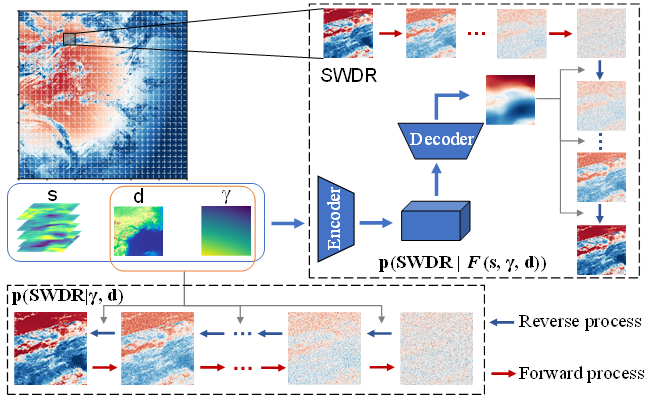
The framework of GenSolar (Image by PAN Baoxiang)
Current forecasting systems typically fall into the following two categories of methods: (1) Numerical weather prediction models explicitly simulate atmospheric processes using the fundamental laws of physics and have served as the backbone of operational weather forecasting for decades. While highly capable, these models require substantial computational resources and often struggle to fully capture the rapid evolution of small-scale cloud systems. (2) More recently, deep learning has emerged as a powerful alternative by learning statistical relationships directly from large volumes of historical observations and model data. These data-driven approaches can produce forecasts much more efficiently, but most existing models generate only a single deterministic prediction.
However, there is rarely one uniquely correct forecast because, according to Dr. PAN Baoxiang, one of the corresponding authors of the new study, “In reality, the atmosphere is inherently chaotic. Tiny differences in the current state of the atmosphere can evolve into noticeably different weather conditions only a few hours later.” Instead, forecasters seek to understand a range of plausible future scenarios and the likelihood of each occurring. This information is especially valuable for renewable energy applications, where operators must continually balance electricity supply and demand while accounting for uncertainties in solar power production.
GenSolar, the new framework, embraces this probabilistic perspective through the use of diffusion models, one of the most rapidly developing classes of generative artificial intelligence. Diffusion models have attracted widespread attention for their remarkable ability to generate highly realistic images by gradually transforming random noise into meaningful visual content. In this work, the same underlying principle is adapted to atmospheric forecasting. Rather than generating photographs, the model learns how realistic solar irradiance fields evolve under different meteorological conditions. During prediction, it begins with random noise and progressively refines it into a physically consistent forecast that is constrained by current atmospheric observations. Because different realizations of the initial random noise naturally lead to different but equally plausible outcomes, the model efficiently produces an ensemble of forecasts representing multiple possible future evolutions of the atmosphere.
This capability represents an important advance over conventional deterministic prediction. Instead of answering only the question of what is most likely to happen, the model also estimates what could reasonably happen. The resulting ensemble provides a comprehensive description of forecast uncertainty, enabling users to assess the confidence of predictions and better prepare for low-probability but potentially high-impact events.
Another key contribution of the study is its ability to generate forecasts at kilometer-scale spatial resolution. Cloud fields often exhibit fine-scale structures that strongly influence local solar irradiance but are difficult to represent using coarser-resolution forecasting systems. By resolving these smaller-scale variations, the proposed framework captures the spatial heterogeneity of cloud evolution more faithfully, providing more detailed information for photovoltaic power forecasting and regional energy management.
Extensive evaluations demonstrate that the generative AI framework consistently outperforms existing forecasting approaches across a wide range of verification metrics. Beyond improving deterministic prediction accuracy, the model produces ensembles whose spread closely reflects the actual uncertainty of atmospheric evolution. This balance between accuracy and reliability is essential for probabilistic forecasting, as an ensemble is valuable only if it realistically represents both the most likely outcome and the range of possible alternatives.
“Although the present study focuses on solar irradiance forecasting, its significance extends well beyond a single application.” Said XIAO Ziniu, also one of the corresponding authors. “Many geophysical prediction problems—including precipitation, wind power, severe weather, hydrology, and climate risk assessment—share the common challenge of representing uncertainty arising from complex nonlinear dynamics.” The generative AI framework developed in this work provides a flexible foundation that could be adapted to a broad range of Earth system prediction tasks where uncertainty quantification is as important as prediction accuracy itself.
The study highlights the growing convergence of atmospheric science and generative artificial intelligence. Rather than viewing uncertainty as an unavoidable limitation, the proposed approach treats it as an integral part of the forecasting process. By generating multiple physically realistic future scenarios, the model provides richer and more actionable information than conventional single-value forecasts. As renewable energy continues to expand worldwide, advances in probabilistic forecasting of this kind will play an increasingly important role in supporting resilient power systems, improving operational decision-making, and enabling the efficient integration of clean energy into modern electricity grids.
Paper info:
Zhenlu Liu, Baoxiang Pan, Jie Chao, Jin Xu, Han Du, Jingnan Wang, Weidong Li, Shuojie Gao, Congyi Nai, Yanyan Cheng, Jinman Zhang, Zengbao Zhao, Shuang Zhou and Ziniu Xiao, 2026. Km-scale solar irradiance ensemble forecasting with generative deep learning. npj Artificial Intelligence, https://doi.org/10.1038/s44387-026-00133-y.