Warming weakens the Asian monsoon's reach into the Mediterranean
Date:2026-09-24
Monsoons and the dry subtropical regions to their west are not isolated parts of the climate system. Intense monsoon convection releases large amounts of heat into the atmosphere, triggering large-scale circulation changes that promotes sinking air thousands of kilometers away. This connection, known as the “monsoon–desert” mechanism, has its most prominent manifestation in terms of South Asian summer monsoon and the Mediterranean.
During summer, large-scale sinking motion over the Mediterranean suppresses clouds and rainfall and contributes to the region’s hot and dry climate. Studies have shown that heating associated with the South Asian monsoon helps drive this descending circulation over the Mediterranean. But whether this long-distance atmospheric connection will survive global warming has remained poorly understood.
A new study, recently published on Nature Geoscience led by Prof. Tianjun Zhou’s group at the Institute of Atmospheric Physics, Chinese Academy of Sciences, shows that this tele-connection is projected to weaken substantially in a warmer world.
The researchers combined real world observations, dozens of climate model simulations and idealized numerical experiments to examine how the year-to-year link between the South Asian monsoon and Mediterranean summer climate changes under high emissions in the future.
The signal is remarkably consistent. In the CESM1 large ensemble, 97.5% of the members showed a weakened Mediterranean atmospheric response to the South Asian monsoon. The relationship between monsoon heating and mid-tropospheric subsidence over the central and eastern Mediterranean fell from a correlation of about 0.4 to essentially zero by the second half of this century.
Why does monsoon’s remote influence on the Mediterranean fade away in the future?
One key change occurs in South Asia. As the climate warms, monsoon’s deep convection becomes higher in the troposphere. In the large-ensemble simulations, the characteristic convection level shifts from about 452 hPa to 417 hPa, with a similar upward shift appearing across CMIP6 models. As a result, the warm response produced by monsoon heating spreads farther west and reduces the east–west temperature contrast over the Mediterranean, which suppresses the subsidence through atmospheric dynamics.
A second process acts locally over the Mediterranean. The monsoon-related sinking weakens most strongly in the middle and upper troposphere. Through an intrinsic atmospheric rule called ‘Sverdrup balance’, this change also weakens the northerly wind response at mid-to-lower levels. The weaker northerlies further reduce the descending motion, creating a local feedback that reinforces the remote effect of the changing monsoon heating.
The consequences can extend from atmospheric circulation to rainfall. Today, stronger South Asian monsoon heating tends to generate stronger subsidence thus less summer rainfall over the Mediterranean land. Under future warming, this relationship largely disappears, with the fraction of rainfall variance explained by the monsoon falls from about 14.2% to 5.1%.
This does not mean that Mediterranean rainfall itself will become less variable. Rather, it indicates that the South Asian monsoon will account for a much smaller share of the year-to-year rainfall variability, implying a transition on controlling factor of Mediterranean summers under the disappearance of ‘monsoon-desert’ coupling phenomenon.
“Global warming does not only change the mean state of temperature and rainfall. It can also reorganize the dynamical links between distant parts of the climate system,” says Prof. Tianjun Zhou, corresponding author of the study. “The changing monsoon–desert coupling phenomenon across Eurasia provides a new dynamical perspective on how large-scale modes of climate variability and teleconnections may evolve in a warmer world. It also means that future projections of Mediterranean summer rainfall need to account for changes in the factors that control its year-to-year variability.”
“Our study highlights a broader feature of climate change: atmospheric connections that appear robust today may not remain so under global warming.” says the lead author of this study, Dr. Hanzhao Yu, “Understanding how such teleconnections change will be important for projecting future regional climate variability, especially in climate change hot-spots such as the Mediterranean.”
This study is supported by National Natural Science Foundation of China (grant no. 42588201).
Paper info:
Yu, H., Zhou, T.,* and Guo, Z., 2026: Reduced Asian monsoon influence on Mediterranean summers in a warmer climate. Nature Geoscience. https://doi.org/10.1038/s41561-026-02091-1.
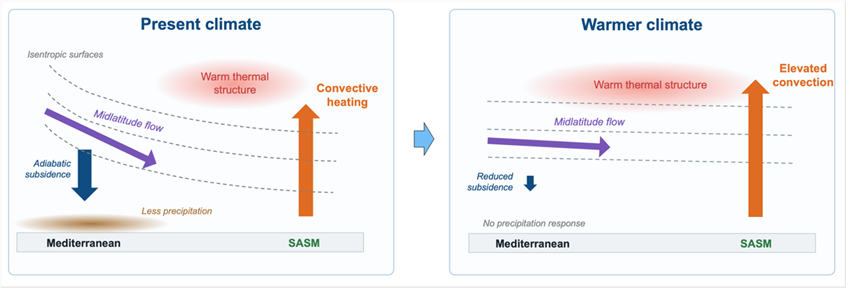
Schematic diagram of weakened Mediterranean summer climate response to SASM. Left: Present-day condition; Right: Climate condition under future warming. (Credit by YU Zhaohan)