Chinese Scientists Develop New Model to Accurately Assess Global Salt Marsh Carbon Sinks
Date:2026-03-04
A research team from the Institute of Atmospheric Physics, Chinese Academy of Sciences, has developed an innovative model to accurately assess the carbon sequestration capacity of global salt marshes, addressing a long-standing gap in blue carbon accounting.
The new model, named SAL-GPP, is the first process-based model specifically designed for salt marsh ecosystems. Unlike traditional terrestrial carbon models that overlook coastal-specific environmental factors, SAL-GPP uniquely incorporates tidal and salinity stress modules to simulate photosynthesis in both C3 and C4 salt marsh plants across different salinity gradients.
"Salt marshes are among the most efficient blue carbon ecosystems on Earth, storing substantial amounts of carbon despite their limited distribution," said Prof. Li Tingting, corresponding author of the study published in Environmental Science & Technology. "However, previous global carbon assessments have largely missed coastal wetland contributions due to model limitations."
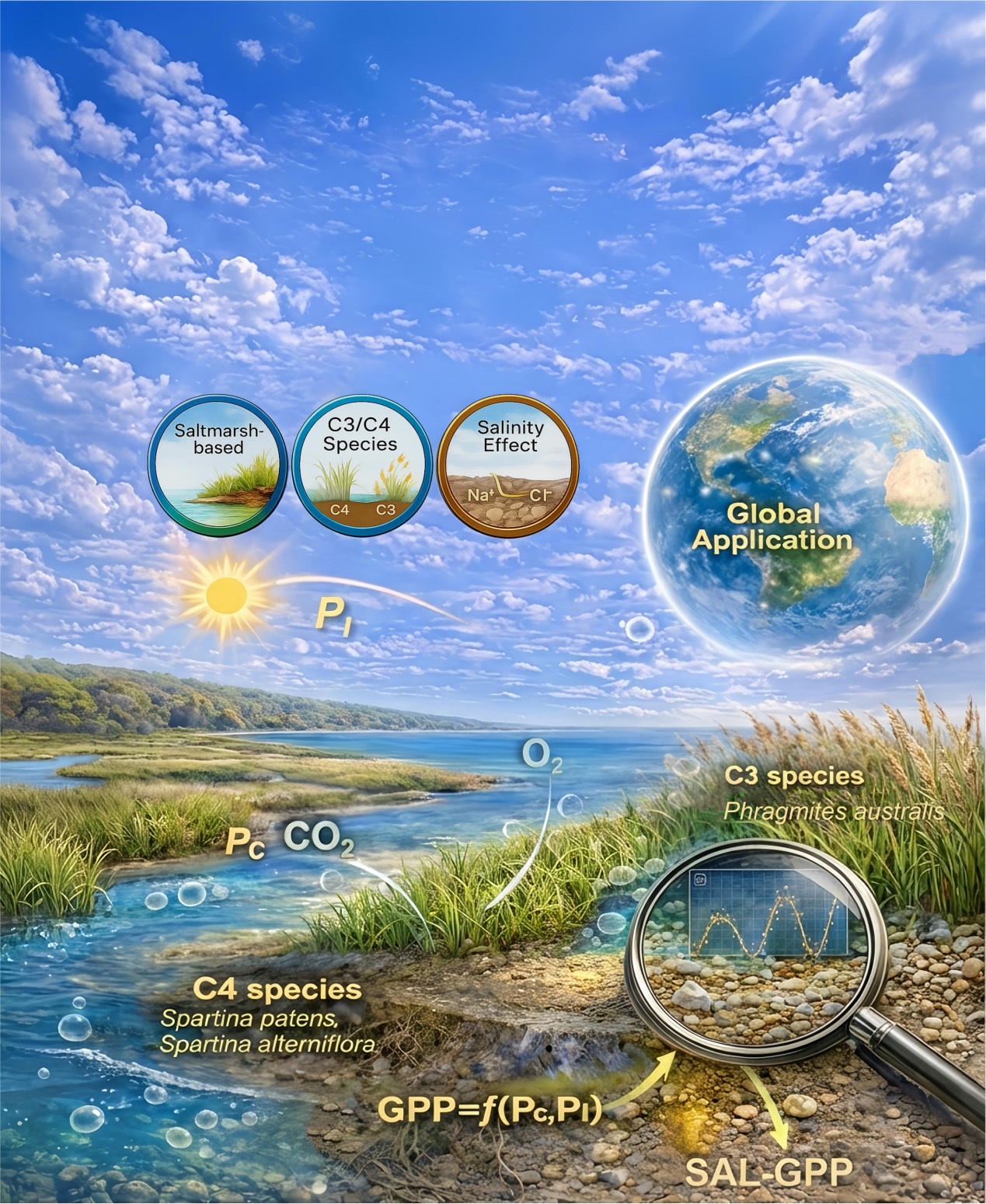
Schematic diagram of the SAL-GPP model framework (Image by Zhou et al., 2026)
The team, including lead author Zhou Zhuoya, a graduate student at IAP, and collaborators from Nanjing University, Tsinghua University, and several CAS institutes, validated the model against multiple flux tower sites worldwide. Results showed excellent performance with a coefficient of determination (R²) of 0.82 for daily productivity simulations.
Using SAL-GPP, the researchers generated the world's first high-resolution (500 m) global salt marsh productivity dataset for 2011-2020. The simulations reveal that global salt marshes have an average annual gross primary production of 66.89 ± 11.68 Tg C yr⁻¹, with hotspots in the southeastern United States, Western Europe, China's southeastern coast, and Australia collectively contributing nearly 64% of the global total.
The dataset demonstrates superior accuracy compared to mainstream remote sensing products like MODIS, GLASS, and GOSIF, as well as 17 TRENDY model simulations, providing crucial scientific support for incorporating coastal wetlands into global carbon budgets.
The research was supported by the National Key Research and Development Program and the National Natural Science Foundation of China.
Paper info:
Zhou, Z.; Li, T.; Yang, X.-Q.; Chen, D.; Han, G.; Fan, X.; Zhao, X.; Wei, S.; He, B.; Wang, G.; Qin, Z., Supporting Blue Carbon Accounting: A Process-Based Productivity Model for Global Salt Marshes. Environmental Science & Technology 2026, doi.org/10.1021/acs.est.5c05527.